Showing posts with label Kazantzakis. Show all posts

4.03.2006

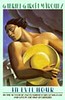
Book Review: THE MASTER & MARGUERITA, by Mikhail Bulgakov

The devil comes to Moscow. Chaos ensues. There's a bit of a love story, but mostly a long cast of characters (who are hard to keep straight because they're all Russian and so have five or six nicknames) meets an assortment of bad ends at the hands of the devil's wiley cohorts. It's a rowdy book, written during Stalin's Soviet regime (here are some biographical notes on Bulgakov), and suppressed until 1966, thirty years after Bulgakov's death, when his wife released it for publication.

Each character is trapped by his own vice (by greed, lust, etc.), and none of the characters come off looking particularly well, though I certainly liked some of them better than others--specifcally Koroviev and Behemoth. There's also a very interesting bit of reworking the gospel that occurs as Pontius Pilate makes an occasional appearance. Tampering with the gospel nearly always wins points with me, so long as it's done in a "tampering to examine the possibilities" sort of way, as opposed to "tampering to fit an agenda" (my favorite example of the first sort of tampering is Nikos Kazantzakis' The Last Temptation of Christ).

A fun book, chock full of devious behavior, social criticism and the brilliant line "Manuscripts don't burn." Reminded me a bit of Neil Gaiman & Terry Pratchett's Good Omens, but better, because it's Russian.

(Here is an interesting and related link.)

RATING: 4

11.04.2005

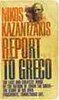
Book Review: REPORT TO GRECO, by Nikos Kazantzakis

Something tells me I'm in over my head, here. What, review the "spiritual journeys" of the incredible Nikos Kazantzakis, with only my wits, my feeble understanding of the book and a four-year degree to help me? Bah. But I'll give it my best shot:
This is the closest to an autobiography that Nikos Kazantzakis gets, and it starts out beautifully, at the close of his life, with a preface by his wife Helen that begins: Nikos Kazantzakis asked his God for ten additional years in which to complete his work--to say what he had to say and "empty himself." He wanted death to come and take only a sackful of bones. Ten years were enough, or so he thought.

That should tell you something of the fierce passion that consumed Kazantzakis, a passion that is evident in his every word--in every book of his I've read (The Last Temptation of Christ, The Greek Passion and the first half of Zorba the Greek), but particularly this one, he presents characters so wracked with anguish, so driven to suffer and find God, that it's almost necessary to set the book down every few paragraphs and take a deep breath. All souls are bared, and GRECO is all the more intense because it is Kazantzakis whose spirit is offered up for the reader.

GRECO is not a strict autobiography--Kazantzakis makes no bones about that--and so it does not necessarily chronicle his experiences. Instead, GRECO follows Kazantzakis throughout his life as his understanding of God evolves, through his experiences, through the people he meets, through his work, and his particular road to God takes a fascinating course.

High points? The best chapter, in my opinion, is "Massacre", near the beginning of the book, when Kazantzakis encounters his "first" massacre as a boy--after this chapter, his father, who had until then been a gruff and inaccessible character to me, earned a whole lot of my respect, in a way that caught me completely off guard. Some of my other favorite chapters were the ones telling of Kazantzakis' pilgrimages to monasteries all over the continent, though his studies are not limited to Christianity: in his travels he encounters not only the Greek Orthodox church, but also Nietszche, atheism, Communism, Greek patriotism, Buddhism--his is an unslakable thirst, and the conclusions he comes to are awesome.

Which is to say nothing of the writing. Every sentence I read, I wanted to mull over individually, pronouncing each word outloud, they were all so lovely--but it took me long enough to read the book as it was, so I stuck to silent reading. His descriptions are gorgeous enough to rival those of Nabokov (and that's saying a lot, you know) and the scenes in Crete were my absolute favorites--lemon blossoms and lusty women, and so on.

In closing, I give you the best opening paragraph I've read in a long, very long, time:
I collect my tools: sight, smell, touch, taste, hearing, intellect. Night has fallen, the day's work is done. I return like a mole to my home, the ground. Not because I am tired and cannot work. I am not tired. But the sun has set.
RATING: 4

10.12.2005

Book Review: IN EVIL HOUR, by Gabriel Garcia Marquez

Ah yes, another author I've been meaning to read since the dawn of time: Gabriel Garcia Marquez, he of the many thin books, of the few fat ones, of the Nobel Peace Prize. I own both Love in the Time of Cholera and One Hundred Years of Solitude, but have I read them? Alas, no. Instead I've read the nice, skinny novels, Of Love and Other Demons and now IN EVIL HOUR.
HOUR takes place in an unnamed Colombian town, and begins with a murder--the result of the spread of the dreaded "lampoons" (think tabloids, but they're about you and somebody saves you the trouble of sneaking peeks in the grocery line by nailing it to your front door). The reaction of the citizens and the town's politicians forms the foundation for HOUR's plot, which Marquez builds up with remarkable skill until the comedy of the lampoons is replaced, subtly and very stealthily, by a tense drama of oppression and politics.

Of course, I was lacking some political context (this is nothing new), so I caught onto the shift in plot a bit late, but Marquez depicts a struggle so gripping that, after a few chapters, the context seemed more beneficial than necessary, and the way in which he twists events just slightly felt to me very much like the maneuvers of a dictator sidling into power.

And that just gives me the shivers.

The novel could have been much longer, but Marquez isolates a key point in the disintegration of the town and focuses on it, removing it from the town's history so that the book starts and finishes abruptly. To the reader, it seems that the story continues on in either direction, unrecorded.

One problem I had, though, was with the translation. I mean, you just can't trust 'em sometimes, and this one seemed a little off. Sometimes the phrases just felt awkward, but other times the characters went around referring to a lady as "so-and-so's wife" when a big part of the scandal was the fact that the lady was not married to the aforementioned gentleman, but was bearing his child. See?

And my plight was made all the more difficult by the fact that I'm also currently reading Kazantzakis's Report to Greco, and the translation from the Greek is magnificent. Not that I know Greek--I don't--but everything about it feels in place and lovely. Everything is as it should be.

But, back to HOUR: my favorite scene involves a dentist, an abcessed tooth, the mayor and a passel of gunslingers--it's very good. And since HOUR was written just before One Hundred Years of Solitude, and, according to the back of the book, "points to the author's later and flowering greatness," I suppose I'll have to read Solitude now. "Later and flowering." Honestly.

RATING: 3