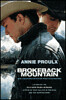
 In true Thea form, I've been putting off watching the movie Brokeback Mountain until I've had a chance to read the story. Once it was brought to my attention that the story was by one of my favorite authors (Annie Proulx) and the movie screenplay by another (Larry McMurtry), and that the movie starred one of my favorite actors (Jake Gyllenhaal), I was sold. And I was very curious to see what all the fuss was about.
BROKEBACK MOUNTAIN is a short story, but it is so intense and so weighty that it does not sacrifice impact for the sake of brevity, not in the least. In fact, I was so emotionally involved with the characters (who were, let's face it, quite emotionally involved with each other) by the end of thirty pages that I could've sworn I'd been reading for much, much longer. Proulx is just that brilliant.
And her writing? Whew. Beautiful. Just right. Does justice to a tough topic. Simultaneously tender and aggressive.
And one of the things I love most about Annie Proulx? Well. I get a bit tetchy when a book is obviously written by a woman--in the extreme, think fluff novels where the main character is savvy and sassy in her slingback heels, juggling careers and boyfriends and so on--or obviously written by a man (with the exception of the marvellous Dashiell Hammett--I do really like him, gunslingers, trashy dames, and all). The books that I love best are generally written by authors who can write a complete and convincing character of the opposite sex and do them justice: think Flaubert, and his notorious Madame Bovary. Or Zadie Smith and her old war buddies in White Teeth. I weary sometimes of seeing women authors write primarily about women, or men write primarily of men (I love Barbara Kingsolver, but she is a bit guilty of this; with a few exceptions, so is Ian McEwan. Atonement is just such an exception).
And so I am delighted when I encounter a woman author who writes convincingly of not just men, but of cowhands, of solitary widowers hitting midlife in a bad way; of generations upon generations of homesteaders, bartenders, immigrants and tradesmen. Also, she writes some fascinating women. She's just good, and in her hands, the story of Jack Twist and Ennis del Mar is given wonderful, if rough, treatment.
Now I have no excuse. I really must see the movie.
RATING: 3


 I really wanted this book to knock my socks off. I did. But the only thing worse than admitting that it didn't is realizing that it might have, had I been in a slightly different frame of mind when I read SATURDAY.
 You know what? I had this really awesome review written up about THE INNOCENT--I mean, awesome, probably the best review I've written in a long while--and I went on and on about how McEwan has these details and these characters and these sneaky little plot twists, and I was so proud of my review, I really was. I was just fine-tuning it, and then Safari "unexpectedly quit."
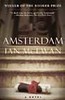 Having read a couple of McEwan's other novels (Atonement and Enduring Love) and, having absolutely loved them, Booker-prize-winning AMSTERDAM came as a bit of a disappointment. Forty-pages into it, I still hadn't quite determined the relationship between the two main characters, Clive Linley and Vernon Halliday. Clive, a successful composer who is finishing a commissioned symphony to mark the end of the millenium, and Vernon, editor of the Judge, both loved Molly Lane, and meet in the very first scene at Molly's funeral.