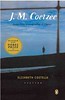
 I wasn't aware that one author could win the Booker Prize twice, but apparently it can be done, because J.M. Coetzee's done it. If you couple that with a Nobel Prize in Literature, I'd say you've got some pretty impressive credentials. At what point does award-winning become excessive, I wonder?
ELIZABETH COSTELLO is one of Coetzee's more recent novels and it is a complicated book, structured in a series of formal addresses given by various characters on various subjects--each of the eight chapters is complete in itself, bracketed by narrative, but centered around an issue like animal rights, "the problem of evil", and so on.
This format is interesting for several reasons, not least of which is the fact that it leaves the reader to make her own decisions about each topic, as each lecture is received dubiously by its audience and critique is offered on each subject, by the characters speaking or by their audience, so that the author's bias and opinion are not readily divined. This gives the book an unsettling murkiness, and made me think a bit more than I cared to, in all honesty. I cannot even pretend that I understood half of what was being discussed.
Coetzee's writing is deliberate and powerful, and for this I loved the first two chapters, and the second to last, "The Gate," all of which relied more heavily on story than on lecture. As much as I loved the rhthym of Coetzee's voice, and however fascinating the ideas being presented, I found myself tempted to skip ahead through many pages of discussion to where the narrative thread picked up again.
Another dubiously good Coetzee book? Disgrace. Both are worth reading, though I could sum each one up in a single word: for Disgrace, I choose "depressing." For ELIZABETH COSTELLO, "intimidating." But don't let that scare you away.
RATING: 3


 Ordinarily, I'm not big on murder-mysteries, but LOST SOULS is a bit different. Though the book doesn't vary much on the mysterious plot (small girl found dead on Halloween--small Midwestern town wonders Who? and Why?), the murder is pretty much solved by the second chapter, leaving Collins with plenty of time to examine the downfall of a failing town and then draw certain parallels between this town and the fall of industry in America--which is interesting, but it's also an awful lot like what he did in his last two books, The Resurrectionists and The Keepers of Truth.
 Somebody asked me once if I'd read this book, and when I said no, they said it seemed like something I would read. I cannot for the life of me remember who said this. If it was you, please put my mind at ease and tell me.
 OFFSHORE is a very pretty little book about houseboats on the Thames River, but it's pretty in a gray, slightly British way. The characters are quirky and intriguing. A lot happens in not very many pages, which I appreciate, and it happens in an artful, subtle fashion. Fitzgerald's got some skills, that much I'll say. And with them, she won the Booker Prize.
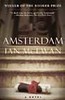 Having read a couple of McEwan's other novels (Atonement and Enduring Love) and, having absolutely loved them, Booker-prize-winning AMSTERDAM came as a bit of a disappointment. Forty-pages into it, I still hadn't quite determined the relationship between the two main characters, Clive Linley and Vernon Halliday. Clive, a successful composer who is finishing a commissioned symphony to mark the end of the millenium, and Vernon, editor of the Judge, both loved Molly Lane, and meet in the very first scene at Molly's funeral.