12.24.2005

Book Review: AN IDIOT GIRL'S CHRISTMAS, by Laurie Notaro

You may or may not have read Notaro's first book, The Idiot Girl's Action Adventure Club--I have not. However, I have read her third (?) book, I Love Everybody (And Other Atrocious Lies), and so I was familiar with her writing, a bit.

IDIOT GIRL'S CHRISTMAS is a collection of funny essays about various Christmases Past in the Notaro family, including the Christmas that Laurie ruined, and the Christmas where Laurie was labelled (twice! On two separate occasions) The Most Unfun Party Guest Ever. The book features six-foot high handmade lawn decorations, nightmarish shopping trips with Nana, and all the check-out line hysteria one could ever ask for. Personally, I loved the Great Christmas Tree showdown, in which Laurie left her tree up until March, just to irritate her already aggravated mother.

Notaro's writing reads, to me, like stand-up comedy. Incredibly conversational, slipping into italics and ALL CAPS, as she, or her family, gets more and more and MORE fiesty, the essays flow off the page as though they're being spoken, and that's impressive, but a whole book of it--wait, two whole books of it--gets old, and quick. It's like an overly long coffee date with a friend who recaps, though animatedly and interestingly, every mundane, mildly funny event that has happened to her over the past week (I know, I'm usually this friend--this is why I have a blog)--after about three-quarters of the book, I was feeling all "talked out", which was funny, because I was reading.

But if you're feeling all Christmassed-out, and you need your holiday spirits lightened, this is a good one--though I'd have to recommend The Best Christmas Pageant Ever, by Barbara Robinson, first.

RATING: 3

12.18.2005

The Birth of Santa

I thought it might be appropriate to write about this: Christmas.

I've read plenty of greeting cards, I've seen plenty of ads on church reader boards crying, He's the Reason for the Season, but that doesn't mean I'm all that great at recognizing the Christian aspect of Christmas--I'd like to be, but I'm not. Like Easter, Christmas has become more a holiday about family, and good food, and traditions like baking cookies and picking out trees and so on, for me--I grew up with Nativity scenes, sure, and we read the Christmas Story, and went to church sometimes on Christmas Eve, but somehow all of that was eclipsed by the more tangible, less boring, facets of the holiday.

Like presents. No getting around that one.

And I don't feel all that guilty about this. Christmas has become so commercialized anymore that it's not really a religious holiday, or at least it doesn't feel like one to me, no matter how many pictures of the Baby Jesus show up in ads for Christmas sales, or how many times I get "Hark the Herald Angels Sing" stuck in my head by January 1, and if I wanted to celebrate it as a religious holiday, well, I'd have to go pretty far out of my way to make it not about food and toys and money.

Bugorama wrote a letter to the editor of the Bellingham Herald (read it here) suggesting that Christians who get all worked up about the word "Christmas" being replaced by "Holiday" in the Wal-mart winter sales might be better off spending the weeks preceding Christmas in church, celebrating Advent, rather than at the mall, and I think she's got a great point.

In the Holiday vs. Christmas battle, I think both sides are being a bit silly (and by this battle, I mean the purging of religious Christmas carols from schools, the renaming of Christmas Break to Winter Break, the Happy Holidays override of Merry Christmas and so on). While I agree that names are important, and that it does matter how we label things, I also think it quite sad that all this energy is wasted on such a silly point. If you celebrate Christmas, fine--go celebrate it. If you're into the Holidays, fine. Go celebrate them.

Try not to worry quite so much what your neighbor's up to, that's all I'm sayin'.

As for me, I celebrate Christmas, even though sometimes the meaning gets a little washed out in my travels from family to family and in my last minute dash to buy presents. This is something I would like to change. I think Bug's suggestion of Advent is a good one--it would definately do me some good to spend the weeks before Christmas reflecting on the story of Christmas and preparing myself, really, to celebrate the holiday with a joyful (not stressed-out) spirit.

Of course, as my dad and step-mom say, my family also celebrates the birth of Santa.

Book Review: THE LORD OF THE RINGS, by J.R.R. Tolkien

I know I am not the first to say so--and of course, I will not be the last--but I think that Tolkien was a genius, and THE LORD OF THE RINGS a masterpiece, a work not bound merely to the Fantasy genre, but one that crosses over into the ranks of great literature--a story so rich and complete in its history, that explores such grand and timeless themes as honor and loyalty and bravery, that THE LORD OF THE RINGS will not be forgotten, I think, for some time.

Reading the trilogy for the third time (and for the first time since all three movies have been released), I was struck by what a wonderful job the movies did of capturing the scenery and characters, and translating them into film--I was also struck by how many aspects there are to LOTR that could not be carried over to film without being cheapened, or robbed of certain intricacies, so I am grateful to the filmmakers for leaving these things intact, and out of the movies completely. As much as I complained that Tom Bombadil was cut, I find now that I'm glad to have him still whole in my imagination, with all his oddities and ambiguity. He is a three-hour film unto himself.

Another thing I noticed, in re-reading the books, was that I was able to concentrate more on the history of Middle Earth, to read the songs and stories and folklore more closely, because I am now so familiar with the story that I was not as bogged down in the description and scenery (of which there is plenty) as I read.

Part of what makes these books so great is the feeling that this immense trilogy, full of end-times forboding and huge, fate-of-the-world actions, is but part of a much longer, more complicated history--I've not read The Silmarillion, but I hear that it is a "brief" history of Middle Earth, complete with the back-stories of characters barely touched on in LOTR [note: I have now read The Silmarillion. My review is linked below], and it is definately on my list of books to read. (I also need to re-read The Hobbit, so you may have a few more Tolkien reviews coming your way.)

Tolkien's trilogy is incredibly textured, rich with various cultures and languages and history, but through it all runs a sorrow, the sadness of an era ending, as the Elves leave for the Havens and all the free people are threatened by a Second Darkness--and Tolkien upholds this sense of decay, but he also sustains a sense of hope, through all three books so that they are consistent and do not lag or lose steam, ever. Although there is a lot of walking through various landscapes.

It is my opinion that The Return of the King (Book 3) is one of the best books ever written, and so I would recommend that, if at all possible, you find a few uninterrupted days in which to read it--the first time I read it, I was recovering from surgery, which was perfect, but this time, I stole a few pages between buses and on my lunch breaks, which was not good at all. If you cannot manage enough time for the whole book, then at least set aside an evening for the Battle of Pelennor Fields, because that is, I think, the best part of the whole trilogy--though my love for Eowyn and Theoden makes me a bit biased, I suppose.

If you've put off reading THE LORD OF THE RINGS because it looks too big or daunting, well, stop that right now and go read it.

Best book ever. I will say no more.

RATING: 5

12.14.2005

An excellent point

Three years ago today, I was gettin' hitched to Mitch! Yee ha!

12.12.2005

Movie Review: Narnia: The Lion, The Witch & The Wardrobe


For the last month or so, I've been radiating enthusiasm for this film--I mean, enthusiasm has been rolling off me in giant waves, like an aura, or bad body odor--and this is the sort of situation that sets one up, sorely, for disappointment.

So, was I disappointed?

I was. A bit.

But there's context involved here: part way through the movie, I was stricken down by a headache of such tremendous strength that I actually threw up later that night, and if that was too much information, I apologize, but I have to set up for you what a very bad headache I had, and how my first viewing of The Lion, The Witch and the Wardrobe came to be so badly tainted. I found myself actually hoping the movie would end so I could go home and lie very still in a very dark room.

I did say that I was only "a bit" disappointed, after all, and I'm sure it's nothing a second viewing can't fix, because the first half of the movie was perfect--so much so that I, overexcited as I was, actually started crying when Lucy opened the door to the wardrobe room and there was the wardrobe, draped all mysteriously in a drop cloth, every bit like I'd pictured the room, and Lucy, and the wardrobe. I didn't calm down all through that scene, as she stepped through the coats and into Narnia for the first time, in a scene so simple but so powerful, because it drew me back into childhood, and my first encounter with Narnia.

However, I know now that I went into the theater with mercilessly high expectations. I could forgive the makers of the Lord of the Rings and Harry Potter films their cutting and rearranging, but I think I honestly expected that, because the book is so short, that Narnia needed nothing--that the film could follow the book scene for scene, word for word.

I didn't realize that I thought this until Edmund took off for the White Witch's castle, and the movie, which had kept til then so close to the book, broke off onto its own track, and scenes began to overlap and characters appeared that, try as I might, I could not remember from the book, and suddenly, things were just different, and I--startled and disoriented and well into The Headache--could not keep up.

They actually invented an action sequence, and I couldn't get past that.

By the time the movie reconnected with the book (only a few scenes later--I don't mean to exaggerate), I had a hard time getting back into the swing of things, and so I missed out on all the fun of the battle, and Aslan, and so on--though I did not miss out on the fact that the White Witch kicked ass. Literally. She was so stinkin' cool.

I've read a couple of reviews of the movie that docked points for the director's heavy hand with the special effects--one even complained that the Narnian snow was too "film studio frosty"--but that didn't both me, so long as the effects didn't get so out of hand that they flattened the characters or the story, for that was my primary concern: the characters, and the story.

And I thought the characters fared incredibly well: the kids were cast pretty much as I pictured them, the White Witch was better than I'd imagined, the Beavers and Mr. Tumnus and Aslan were beautiful, and the sets were near perfect.

My complaint, really, is a small one, and what it comes down to is that I need to see the movie again, sans headache and high expectations--I think I will enjoy Narnia much more the second time.

----------


I've heard two rumors:
a. that a Narnia movie will be released every Christmas for the next 7 years, and
b. that Disney is waiting to gauge the response to Lion, Witch and so on before they begin filming Prince Caspian.
Anybody know which it is? Please, please tell me it's (a).

12.03.2005

The Cookie Strikes Back

Last night, Mitch and I found ourselves at a Holiday Festival, where a Gingerbread-House-Building contest was underway. I don't think I'd ever fully appreciated the art of gingerbread houses until I beheld the intricacies of building rooftops out of everything from Frosted Mini-Wheats to wee, teeny, undoubtedly hand-cut squares of chocolate. Little stone walls, made of thick white frosting and rock candy. Trees built from green star-shaped cookies, stacked one atop the next in dimishing sizes!

We're not talking about gingerbread houses made from a kit, oh no. These are people who do this every year, who somehow manage to construct Whatcom County landmarks like the county museum, Mt. Baker theater or Mt. Baker itself out of all things candy-coated and edible, who probably draft out their houses before they begin and stock up on stale candy months in advance.

These are hardcore gingerbread-house-builders.

And none more so than the participant who submitted...a skyscraper. A four-foot-high, gingerbread skyscraper, with lights in the windows, a full city block as its base (complete with taxi cabs and police cars made of artfully rearranged Peeps), and, as a finishing touch, a foot-high recreation of the giant gingerbread man from Shrek 2. Hanging from the side of the skyscraper, angry and clutching a miniature Santa in his cookie hand.

Utterly amazing. Breathtaking to behold. And entered, of course, by an engineering company.

11.29.2005

Today, I am thankful for:

Fleecy mittens and hair dryers.

Just like that, winter is upon us, in all it's slushy, fat-flaked glory. Walking to the bus depot this morning in my many layers and insensible shoes, I noticed all sorts of gorgeous, nature-y things--a bird flitting about the wet branches of a maple tree; clouds, snow-heavy and blue, growing darker and lower by the second; obscenities traced in the snow by some well-meaning punk.

At work, we had two cancellations due to the snow, which, in town, was nothing more than a few pretty inches that melted off just past noon. In the county, I'm sure it was much more dramatic, and I miss that about living in the county: getting the snow first, and having a solid reason to cancel things. As it was, everybody on the bus had nice puddles around their feet, and rosy cheeks and noses, and everyone said chipper things like, "Cold out there, isn't it?", or grumpy things like, "Cold out there, isn't it?"

I notice: snow is a whole heck of a lot more fun when you don't have to drive anywhere.

I don't have to drive anywhere.

11.28.2005

Book Review: OF MICE & MEN, by John Steinbeck

I will tell it like this: you're watching a movie in black and white, and the movie is interesting and nice, nothing special, but every now and then will be a little flash of color--a ruby ring lit up, brilliant and red; a porchlight, flickering, suddenly gold--and the flashes are so quick that they are not fun, but jarring. As the movie goes on, they happen more and more often, an eerie sort of foreshadowing--and when the climax comes, it is all alight in these vivid, almost disturbing colors. The movie ends like that: in violent color.

I did not see what the big deal about John Steinbeck was, not until the last three pages of OF MICE AND MEN. I see it now.

RATING: 4

11.27.2005

Cue trumpets and theme music!

...something like the theme to Mission Impossible.


11.26.2005

Book Review: POSSESSION, by A.S. Byatt

Somebody asked me once if I'd read this book, and when I said no, they said it seemed like something I would read. I cannot for the life of me remember who said this. If it was you, please put my mind at ease and tell me.

I'm a complete sucker for recommendations, at any rate, so at the recommendation of this Mystery Person, I bought POSSESSION and I read it. And I enjoyed it, very much.

It's no wonder that Byatt won a Booker Prize for POSSESSION: part suspense, part romance (not that kind of romance), and two or three parts literature, Byatt's novel follows young Roland Michel, a scholar on the fictional late nineteenth century poet, Randolph Henry Ash, as he accidentally discovers two as yet unseen letters of Ash's in a library book. The letters set Michel on the trail of the unknown woman to whom Ash was writing and, with the help of another scholar, Maud Bailey, he uncovers a story that blah blah blah.

I'm sorry. My summary is so terribly insufficient.

When written up like that, POSSESSION sounds like nothing more than a stock thriller plot, with a little history and poetry mixed in. Forgive me. It is so much more.

Byatt's writing is incredible--whether you like them or not, her sentences are impressive, long and lovely, the words and images she chooses wildly beautiful--and her sense of structure is magnificent. This is the sort of book that begs to be examined in college literature classes--I couldn't help but notice certain themes running through the story (the word "possession", in every possible sense, being one of them), and the way Byatt wove in bits of poetry by her fictional poets, or entire journals written by various characters, and yet kept the voices of each character, whether writing or speaking, perfectly clear, added many, many more layers to a story that was already rich and glowing.

I liked it. I really did. For you Victorian literature buffs, this is a great mix of contemporary and classic literature, complete with epic poems and scenes set in Victorian England. Postively lovely.

RATING: 4

11.22.2005

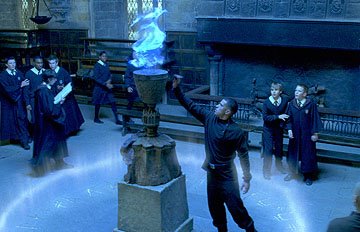
Movie Review: Harry Potter & The Goblet of Fire

(If you haven't seen the movie, back away slowly; if you haven't read the book, run!)


Oh, I could kiss all the fine folks involved in Harry Potter and the Goblet of Fire, I really could, and here's why:

They got the graveyard scene just right.

Perfect. Exactly (exactly) how I pictured the whole thing--and Voldemort, well. I was hyperventilating by the time they finally showed his face, I was that excited, and he was perfect. Exactly how I'd imagined him.

Also:

Whatever else they cut (lots, and lots) they did not cut the ferret scene. Hallelujah.

I truly admire the brave souls who undertook this most monstrous of tasks, because the question is not only How do you make a movie of a book the size of a small child? but also How do you squeeze in all those bloody subplots without making an eight hour movie, and What can you take out without damaging the story beyond repair?

Whew. I couldn't do it.

Even though Goblet whipped by, in all its two-and-a-half hour glory (not only because I was so engrossed in the film, but because the whole thing is contrived of quick, quick, little scenes--so many things squeezed in!), and even though it relied rather heavily on the assumption that the viewer has, of course, read the book, I was astonished at how much they did fit in. Really, I can't complain.

Much.

Because what is a review, if it just gushes on and on about how friggin' cool the movie is?

So here is my complaint:

Barty Crouch. Both of them. In attempting to shorten that particular subplot, I feel a whole lot was lost--for example, reading the book I was tremendously conflicted about Barty Crouch, Sr. What kind of man sends his son, screaming and protesting his innocence, to prison, really? And then helps his son escape, only to keep him imprisoned by a house elf for ten years or so?

I couldn't decide, but I sure didn't like the guy.

In the movie, sure, Mr. Crouch is pretty intense toward the beginning, but mostly he's no more worth considering than Fudge--not terribly likeable, a little shifty-eyed, but overall, I wasn't able to form much of an opinion about him at all.

Now, really, I can handle the absence of Winky the Elf; I can handle not getting even a glimpse of the LeStranges (Bellatrix, in particular, I'd been hoping to see), and I suppose I can bear the loss of the Percy Weasley subplot--but I'm not sure I can cope with such a complete alteration of Barty Crouch's character that he comes out looking like a victim. What was that about him admitting to Harry that he'd lost his family? I'm pretty sure everybody else was muttering about the scandal behind his back, in the book, but there he was, all soggy-eyed, confessing to Harry that losing one's family changes one forever.

And then he just dies.

And his death is only mentioned once, right after it happens, and nobody seems terribly concerned about how he died, or why, or, particularly, who killed him.

I suppose that little gaps in logic like that (or perhaps gaps in my attention span--there might've been more to it that I missed, I admit, and I apologize in advance if I'm wrong) are permissable in a huge, brilliant movie like this, and, though I caught a couple others, only one more is worth mentioning:

Barty Jr. went to Azkaban. As far as we (the viewers) know, there's no mention in the movie of him escaping/faking his death/and so on; also, as far as we know, Sirius Black is the only one to have escaped Azkaban, ever. But when Barty Jr. is apprehended, Dumbledore turns to a teacher and says, "Call Azkaban, I think they'll find they're missing a prisoner."

What?

Does he mean that the dementors hadn't noticed Barty's absence, or that he'd escaped, but there'd been absolutely no brouhaha about it at all?

If I missed something, please, correct me.

In summary, though, The Goblet of Fire rocked--the maze, even without the blast-ended skrewts and the Sphinx, was way cooler than I could have imagined, and Fred and George were in the film a bunch (a sure way to make me happy), and the kids' acting has improved so much, and the dragons, and the mermaids, and oh! Mad-Eye Moody...

They did my favorite book in the series (so far) such spectacular justice, I was up all night rehashing it, and I'm afraid I drove my husband quite crazy--but ah, well. He ought to know what he's in for: Narnia's up next. They make two of my favorite books into movies and then release them within weeks of each other. I can't stand it; I might explode.

11.21.2005

Draco Malfoy is a total hottie

I'm leaving (mere minutes from now) to go see The Goblet of Fire.

Positively, I'm giddy.

11.19.2005

Book Review: WEETZIE BAT, by Francesca Lia Block

When I was in high school, I was absolutely in love with Francesca Lia Block and her Weetzie Bat books (there are five; I am reviewing only the first, WEETZIE BAT), but upon my reintroduction with Weetzie, I approached them very differently. Something in Block's relentless optimism through the first half of the skinny book put me off initially--everything is lovey-dovey cotton candy clouds in LA, it seems like--and I was close to the end of the book before I came back around and began to see the appeal of WEETZIE: Block's writing, though jam-packed with images and details, is incredibly direct, and this directness pares difficult themes like AIDS and abuse and grief and, that reigning queen of young adult fiction, "being different," down and shows them simply as they are, not in a different light, nor in a revelatory way. They're difficult issues, really, and I think she does them justice. WEETZIE is a brave little book, when it comes down to it. I like that. And the whole thing's so darn pretty.
RATING: 3

11.11.2005

Book Review: IN COLD BLOOD, by Truman Capote

When no fewer than three people stop you in the bookstore to point out what a great book it is you're considering, one can't help but have certain high (very high) expectations of said book. Two of the people who stopped me were employees; the third was a stranger with a pronounced German accent. I took them at their word, and bought IN COLD BLOOD.

I was not disappointed. I was not in the neighborhood of disappointment, nor perhaps, in the same town as disappointment. I'll say it, too: IN COLD BLOOD is a great book.

Published in 1965, IN COLD BLOOD reconstructs the brutal murder of four members of a prominent ranching family in the small town of Holcomb, Kansas, and follows the investigation of the near-perfect crime to its resolution. Capote's sense of timing and the pacing of the story are flawless: he depicts an entire community as it suffers the fall-out of this vicious crime, and as its citizens begin, for the first time, to distrust one another; he portrays the killers and their victims with a skillful empathy that displays the subjects' many facets in a curiously objective light.

IN COLD BLOOD is a fascinating study of violence that is at times disturbing, at times uncomfortable, but always unflinchingly honest. Several times, Capote gave me chills--his mastery of language is incredible, so that he could set up an entire scene in a subdued, unthreatening tone, but then knock my socks off with a single image: a lawyer, touching the back of his neck in a courtroom; the lazy circling of a housefly. Of all the varied scenes and circumstances of the book, those deceptively insignificant images were the ones that stuck with me.

To sum up, Capote can use phrases like, "in a pool of his own blood" and make them scary rather than cliche--probably because he said it first, though I couldn't back that up. But I bet he did say it first.

RATING: 5

11.09.2005

11.05.2005

In Which She Procrastinates Further and Feels a Bit Guilty

So, when I said I'd be putting off the blogging for a month in order to knuckle down and write a novel, I didn't realize that blogging would be an excellent excuse to ignore the novel for a bit...

And here I am. Not working on my novel.

But the novel itself, well. 50,000 words is a lot of stinkin' words, did you know that? I spent 4 hours (4 BLOODY HOURS) at the Black Drop this morning--that's breakfast and lunch--and all I've got to show for it is 2,000 more words, a radically revised plot line and a bad stomachache.

The realization that I should be writing 2,000+ words a day hit me then, as I computed "4 hours" into "2,000 words" and felt rather like bursting into tears.

This is fun, remember? Not competitive! Fun! A raging blast, as a matter of fact!

As was inevitable, my computer shut down in the middle of a particularly burly moment of inspiration (not really: by then I was looking for an excuse to pack it in, go home and take a nap--though this was not, of course, what I had in mind), and I hurried home to try and resurrect the sick little laptop and (please, God, please) what remained of my novel.

Thankfully, the novel's still in one piece--all 4500 words. But you know you're getting desperate to meet the word count when you start employing elaborate "In Which He Encounters a Stranger on a Desolate Road and Engages Him in Conversation"-style chapter titles. Eh.

Also, I've taken to changing the background on my laptop every few minutes--another tactic for avoiding work--and it's currently leopard print. All is well in the world.

Book Review: BAGOMBO SNUFF BOX, by Kurt Vonnegut

I'm just going to say it once (I LOVE KURT VONNEGUT), and then I'm going to move right on to the review: I love him. There. I feel better.
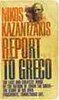
BAGOMBO is a collection of "uncollected short fiction" (yeah, it's collected now, isn't it? Why call it "uncollected"?), from the second half of Vonnegut's career as a short story author. Welcome to the Monkey House is the first volume of Vonnegut's "collected/uncollected" stories, but I haven't read that one, so I don't know it if it's any good--I'm sure it is, because it's Vonnegut.

To sum it up: he's funny! He's satirical! He makes me giggle out loud! His short stories are awesome! That is all.

RATING: 4

11.04.2005

Book Review: REPORT TO GRECO, by Nikos Kazantzakis

Something tells me I'm in over my head, here. What, review the "spiritual journeys" of the incredible Nikos Kazantzakis, with only my wits, my feeble understanding of the book and a four-year degree to help me? Bah. But I'll give it my best shot:

This is the closest to an autobiography that Nikos Kazantzakis gets, and it starts out beautifully, at the close of his life, with a preface by his wife Helen that begins: Nikos Kazantzakis asked his God for ten additional years in which to complete his work--to say what he had to say and "empty himself." He wanted death to come and take only a sackful of bones. Ten years were enough, or so he thought.

That should tell you something of the fierce passion that consumed Kazantzakis, a passion that is evident in his every word--in every book of his I've read (The Last Temptation of Christ, The Greek Passion and the first half of Zorba the Greek), but particularly this one, he presents characters so wracked with anguish, so driven to suffer and find God, that it's almost necessary to set the book down every few paragraphs and take a deep breath. All souls are bared, and GRECO is all the more intense because it is Kazantzakis whose spirit is offered up for the reader.

GRECO is not a strict autobiography--Kazantzakis makes no bones about that--and so it does not necessarily chronicle his experiences. Instead, GRECO follows Kazantzakis throughout his life as his understanding of God evolves, through his experiences, through the people he meets, through his work, and his particular road to God takes a fascinating course.

High points? The best chapter, in my opinion, is "Massacre", near the beginning of the book, when Kazantzakis encounters his "first" massacre as a boy--after this chapter, his father, who had until then been a gruff and inaccessible character to me, earned a whole lot of my respect, in a way that caught me completely off guard. Some of my other favorite chapters were the ones telling of Kazantzakis' pilgrimages to monasteries all over the continent, though his studies are not limited to Christianity: in his travels he encounters not only the Greek Orthodox church, but also Nietszche, atheism, Communism, Greek patriotism, Buddhism--his is an unslakable thirst, and the conclusions he comes to are awesome.

Which is to say nothing of the writing. Every sentence I read, I wanted to mull over individually, pronouncing each word outloud, they were all so lovely--but it took me long enough to read the book as it was, so I stuck to silent reading. His descriptions are gorgeous enough to rival those of Nabokov (and that's saying a lot, you know) and the scenes in Crete were my absolute favorites--lemon blossoms and lusty women, and so on.

In closing, I give you the best opening paragraph I've read in a long, very long, time:
I collect my tools: sight, smell, touch, taste, hearing, intellect. Night has fallen, the day's work is done. I return like a mole to my home, the ground. Not because I am tired and cannot work. I am not tired. But the sun has set.
RATING: 4

11.03.2005

49,399 words to go, and I'm home free!

If I'm quiet through the month of November, here's why--I'm busy feeling bad about not writing. Rest assured I'll be back in December with a whole arsenal of odd happenings, but in the meantime, let's just slow this page down and reflect. Talk amongst yourselves and all that.

Oh, and the Black Eyes & Neckties show at the 3B was awesome. I got beer in my hair and a bad cold and the whole shebang (really? Is it actually spelled like that?), and apparently I was one of the only three people on State St. who didn't dress up for Halloween--Sarah and Lyle, my cohorts, being the other two. Ah, well.

Book Review: CHOKE, by Chuck Palahniuk

Chuck Palahniuk will ruin everything for you: air travel, eating out, tourism, the zoo (especially the zoo), chocolate pudding, movies, and more. You name it, and he'll work it into a novel somehow and wreck it for you. You'll never eat a bowl of soup in a restaurant again without wondering...I, for one, will never again see the zoo quite the way I did pre-Palahniuk, and I'm not sure how I feel about that.
I know I was all ambivalent and conflicted in my review of Fight Club, and I know that I can't necessarily play at feeling conflicted again after reading CHOKE--obviously, if I've made it through three Palahniuk novels, something's got me coming back. I better just admit that I like him. He's good. Probably either disturbed (bad) or smarter than the rest of us (worse), but I'll say it: Chuck Palahiuk is good. I like his books.

And I'm saying that CHOKE is quite possibly my favorite so far. There's tricky pacing and several surprise endings (thought it was over? No! Here comes another one!) that Palahniuk pulls off grandly--the characters are quirky, but not irritatingly so. He develops them all quite nicely, but I was especially drawn to Ida Mancini and, yes, Victor Mancini himself. Ida's madness is of the brilliant, evil-genius variety and so she was utterly fascinating--the power she has over Victor goes far beyond anything Victor, as narrator, can pinpoint, but it's unmistakably there even when Victor himself can't see it. Haunting.

Which reminds me: I still haven't brought myself to track down that first story of Haunted. Perhaps someday when I'm feeling brave, I'll find it and read it and be changed--or completely grossed out, or what have you. It'll be great.

RATING: 4